Story
17 June 2026
Serving as a soldier without losing one’s humanity: the story of UN peacekeeper Matías Reyes
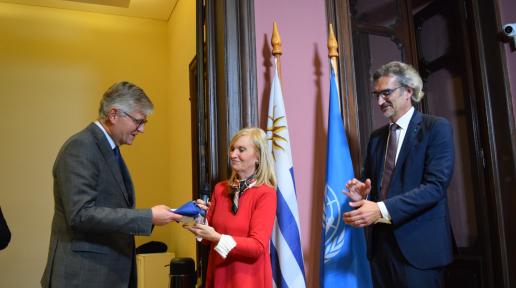
When the camera turns on, in the afternoon in Goma (Democratic Republic of the Congo) and the morning in Montevideo (Uruguay), the composed face of Sergeant Matías Reyes fills the screen. Behind him stands a United Nations flag, and to his right, the flag of Uruguay, his homeland and country of residence. Matías Reyes is serving on his third peacekeeping mission in the Congo. A member of the 14th Parachute Infantry Battalion and the Special Operations Forces of the Uruguayan National Army, Reyes has built an 11-year career in the military.At 32 years old, Reyes gained worldwide recognition for an act of courage and service worthy of a movie script. In 2025, the crisis in Goma, the capital of North Kivu Province in the Democratic Republic of the Congo, escalated dramatically as the M23 rebel group took control of the city. The offensive killed thousands of people and displaced hundreds of thousands more, plunging the region into a severe humanitarian crisis. Goma is home to the headquarters of the United Nations Organization Stabilization Mission in the Democratic Republic of the Congo (MONUSCO), where peacekeepers from several nations work to support peace and stability in the country.In January 2025, after weeks of conflict and armed clashes, a large group of Congolese Army soldiers became surrounded and suffered serious injuries. Reyes, deployed at the MONUSCO base, did not hesitate. Amid intense fighting, he assisted and evacuated wounded soldiers seeking refuge at the United Nations compound. Despite constant gunfire and extreme danger, he rescued 12 critically injured personnel, playing a decisive role in saving their lives.His actions earned him the highest decoration within the United Nations peacekeeping system: the Captain Mbaye Diagne Medal for Exceptional Courage. The award was presented by the Secretary-General on 5 June in New York. Reyes was unable to attend the ceremony in person due to the Ebola outbreak in the Congo, which limited travel opportunities.The distinction was established in 2014 to recognize military, police, and civilian personnel who demonstrate exceptional courage in the performance of their duties. The medal is named after Captain Mbaye Diagne of Senegal, who sacrificed his life in Rwanda in 1994 while saving countless others. It is awarded exclusively to individuals who display extraordinary bravery in the field. Since its creation, the medal had previously been awarded only three times.We interviewed Reyes to help shed light on what it means to be a Uruguayan peacekeeper serving for peace. Below is an excerpt from his conversation with UN Uruguay:When you are under constant fire, facing that level of danger, how do you make the decision to move forward, to assist, to evacuate? In those moments, what carries more weight: training or instinct?In critical situations, there is no room for prolonged reflection. Decisions are based primarily on the training we have received, which enables us to act immediately, in an organized and effective manner. Instinct plays a role, but it is shaped by that training and by experience. In those few seconds, what prevails is the mission itself, carried out with control, discipline, and coordination alongside our fellow soldiers.This took place shortly after the tragic incident that claimed the life of soldier Rodolfo Álvarez...Yes, and the news had a devastating impact, especially on those who were directly involved. It was a reminder of the ultimate sacrifice we are prepared to make, both for the mission and for our comrades. That is when the courage of every soldier had to be renewed: facing that tragedy and still preparing for what lay ahead, which were more days of conflict.At the time, I was not able to fully grasp the significance of rescuing those 12 critically wounded soldiers. Every second mattered, and the priority was evacuation. As I mentioned, we assessed the situation, but beyond the risk and everything else, we did not stop to think about it. The priority was to evacuate those individuals and get them to safety.It was only days later that others helped me understand the significance of what had happened and of what I had done, and I came to accept it as such. I also believe there is a strong sense of duty that is very much part of being Uruguayan, wouldn't you say?"To my fellow peacekeepers, I would say: never forget those who came before us, and continue to honor their example through professionalism, unwavering discipline, and above all, humility and commitment."What does it mean to you to be only the fourth person in the world to receive this medal?Above all, it is a profound honor, but also a great responsibility. It is a recognition that goes beyond the individual and represents the commitment, dedication, and values of an entire unit.I accept it with humility, fully aware of its significance and of the legacy of those who received it before me. More than a personal achievement, I see it as an ongoing commitment to continue acting with professionalism, discipline, and a vocation for service.Uruguay has a long and respected tradition in Peace Operations and is one of the countries that contributes a significant number of peacekeepers to missions around the world. What do you think a Uruguayan peacekeeper brings to the field? How would you describe the Uruguayan peacekeeper?Above all, we bring a high level of commitment, professionalism, and dedication to service.We are characterized by strong training, operational discipline, and a remarkable ability to adapt to complex environments. We are also recognized for values such as humility, respect, empathy, and closeness to local communities, which help build trust and foster dialogue.There is also a deep commitment to protecting lives. As I mentioned before, we always strive to care for and protect the civilian population. We work side by side with contingents from other nations, all serving the same purpose: helping this country achieve peace one day."This medal is a clear example of the highest values represented in peacekeeping service: courage, unity, respect for life, and commitment to the lives of others. Receiving a distinction associated with such a profound honor requires me to carry it with great humility and respect above all else."Peacekeeping missions often take place far from home. You are currently thousands of kilometers away from Uruguay. What have you learned about peace while living in a context of war?I have learned that peace is not something abstract. Peace is built through concrete actions, often in the most difficult circumstances.Especially in a war context, you witness fear, suffering, and the vulnerability of people. But you also see the hope that can be conveyed through every gesture and every decision, because each action we take can make a difference in someone's life.Serving in a peacekeeping mission means being present when people need you the most.I learned that building peace requires more than words or good intentions. It requires trust, teamwork, and empathy. Most importantly, it requires the actions that turn those aspirations into reality.How does a person, and a family, prepare to serve in such a demanding environment as the Democratic Republic of the Congo? What part of the sacrifice is invisible to those on the outside, during those nights and days when, beyond the training, there must surely be moments of struggle and homesickness?A soldier's moral strength is built on the essential support of their family. That support is key to coping with the demands of the mission and the distance from loved ones.Our preparation is comprehensive: technical, tactical, physical, and, above all, mental. That last aspect is often the most decisive in operational performance.It is also important to recognize the sacrifices involved in a mission like this, not only the separation from family, but also the constant exposure to the suffering of others and the ever-present risk. These are realities that are often difficult to fully understand outside the military environment. It is what makes missions like this possible. Many people do not see the sacrifice involved in being far from one’s country and family. In my case, I am a father, and I have my son, Benjamín. These are very demanding circumstances. That is why family support is the foundation of every soldier’s morale. At least in my case, that is certainly true, and I am deeply grateful for the unconditional support I receive from my family.What did Benjamín say when he learned that you had received this medal?He was very happy. He is 11 years old, and he sees it in a very beautiful way. I am sure he is proud of his father. Well, he sees me as a hero, doesn't he? (smiles)Without a doubt, he is proud, and that is what gives me the strength to keep moving forward and continue contributing until the day I leave here. It is what inspires me every single day.For me, hearing something like that from a son is very special and difficult to describe. Beyond the medal itself, what I value most is being able to pass on, by example, a sense of duty, commitment, and the importance of helping others."As Uruguayan peacekeepers, we are distinguished by values such as humility, respect, empathy, and closeness to the local population."What message would you like to convey to families and to your fellow soldiers regarding this distinction and the comrades who have fallen?First and foremost, I would like to express my deepest gratitude to the families whose quiet and unconditional support is essential for us to fulfill our mission. They are the ones who sustain the soldier from afar and who often share, in silence, the sacrifices that come with serving far from home.To my comrades, I would say that this recognition does not belong to me alone. It is a reflection of the dedication and commitment of all of us. It is a call to continue honoring, through professionalism, discipline, and humility, the legacy of those who gave their lives in the line of duty.To our fallen comrades, I offer my deepest respect. Their example must guide us at all times and remind us of the true purpose of our mission: to serve and to protect.
And after this experience and this distinction, what would you say to a young Uruguayan man or woman who is considering serving as a peacekeeper?I would tell them that it is a great responsibility, but also a great honor. It is not an easy task, because it requires sacrifice, discipline, and preparation. But it also provides the opportunity to help those who need it most. Being able to serve humanity is a source of immense personal fulfillment.I would tell them that the true value of the mission lies in serving, protecting, and acting with humility and commitment at all times.. "I learned that peace is not something abstract. Peace is built through concrete actions, often in very difficult moments. (...) I learned that building peace requires more than words or good intentions; it requires trust, teamwork, and empathy."If you had to define in one sentence what it means to be a peacekeeper after everything you have experienced, what would that sentence be?(Pauses to reflect)To serve as a soldier without ever losing one's humanity.
A final message?I would like to begin by addressing all my comrades, especially those serving in peacekeeping missions across different regions of the world, helping communities and protecting lives. But above all, I would like to say to Uruguayan peacekeepers: never forget the true purpose of your mission and what it represents for us. Never, ever give up, and always keep our fallen comrades in your thoughts.To my family, I want to express my deepest gratitude for their unconditional support. They are always there for me, especially my son, my father, my mother, and my partner.And finally, I would say that the Uruguayan soldier will always be committed to causes such as these: serving and protecting wherever they may be called to do so. It is rooted in our sense of humanity and in the humility and respect that are instilled in us through the military institution of our country."The soldier’s moral strength is rooted in the essential support of their family. That support is crucial in facing the demands of the mission and the distance from loved ones."
And after this experience and this distinction, what would you say to a young Uruguayan man or woman who is considering serving as a peacekeeper?I would tell them that it is a great responsibility, but also a great honor. It is not an easy task, because it requires sacrifice, discipline, and preparation. But it also provides the opportunity to help those who need it most. Being able to serve humanity is a source of immense personal fulfillment.I would tell them that the true value of the mission lies in serving, protecting, and acting with humility and commitment at all times.. "I learned that peace is not something abstract. Peace is built through concrete actions, often in very difficult moments. (...) I learned that building peace requires more than words or good intentions; it requires trust, teamwork, and empathy."If you had to define in one sentence what it means to be a peacekeeper after everything you have experienced, what would that sentence be?(Pauses to reflect)To serve as a soldier without ever losing one's humanity.
A final message?I would like to begin by addressing all my comrades, especially those serving in peacekeeping missions across different regions of the world, helping communities and protecting lives. But above all, I would like to say to Uruguayan peacekeepers: never forget the true purpose of your mission and what it represents for us. Never, ever give up, and always keep our fallen comrades in your thoughts.To my family, I want to express my deepest gratitude for their unconditional support. They are always there for me, especially my son, my father, my mother, and my partner.And finally, I would say that the Uruguayan soldier will always be committed to causes such as these: serving and protecting wherever they may be called to do so. It is rooted in our sense of humanity and in the humility and respect that are instilled in us through the military institution of our country."The soldier’s moral strength is rooted in the essential support of their family. That support is crucial in facing the demands of the mission and the distance from loved ones."